Private Trigger Finger Release Surgery in Canada: Skip the Waitlist
Experience 25+ Years
of Surgical Excellence
Tired of Waiting? Access Private Hand Surgery in 2–8 Weeks
In 2026, the average wait time for orthopedic and plastic surgery in Canada remains a significant barrier to health. Are you suffering from finger locking, clicking, or pain? Do you wake up with fingers that are stiff, locked, or difficult to straighten? Does the simple act of gripping an object cause a painful "catch" or "pop" in your hand?
Trigger finger can turn daily tasks like buttoning a shirt, typing, or holding a coffee cup into painful challenges. If you are experiencing tenderness at the base of your finger, or if your finger gets stuck in a bent position and snaps straight like a trigger, you don't have to live with the discomfort while waiting for a public surgery date
Living with Trigger Finger is frustrating enough without the added stress of a Canadian waitlist. If you are living with the discomfort of Trigger Finger, waiting months for a specialist in BC, Alberta, Saskatchewan, Ontario, Quebec, or Atlantic Canada isn't just frustrating—it risks permanent mobility loss.
At The First Glance, we provide a private, self-pay alternative for Canadians seeking immediate relief. Our streamlined process allows you to travel to our state-of-the-art surgical centre in Winnipeg to undergo surgery, and return home the same day.
Why Canadians Choose Our Private Surgical Centre
- Expedited Access. Bypass public waitlists. We can schedule your surgery in as little as 14 days from your initial consultation
- National Eligibility. We specialize in care for patients from BC, Alberta, Saskatchewan, Ontario, Quebec and Atlantic Canada.
- Specialized Hand Surgeons. Performed exclusively by Board Certified Plastic Surgeons specializing in tendon release and intricate hand repair.
- Fully Accredited. Our facility is governed by the highest safety standards of the College of Physicians and Surgeons of Manitoba.
- Trusted by Patients Across Canada for 25+ Years.
Orthopedic Relief. Aesthetic Precision.
Trigger Finger isn't a bone problem; it’s a trapped tendon. That is our territory. Our training is rooted in the complex soft tissue of the hand.
Plastic Surgeons routinely repair vessels and nerves thinner than a strand of hair. We bring that same level of microscopic precision to your Trigger Finger Release, meticulously releasing the constricting pulley (A1 pulley) while safeguarding the delicate digital nerves that sit just millimeters away.
Plastic Surgeons combine the functional restoration of orthopedic surgery with the delicate tissue handling of aesthetic surgery. The result? The locking stops, smooth gliding returns, and your incision is strategically placed within the natural creases of your palm to heal as a virtually invisible line.
Understanding Trigger Finger (Stenosing Tenosynovitis)
Trigger Finger occurs when the flexor tendon becomes inflamed or thickened, struggling to glide through the protective tunnel (sheath) at the base of the finger. Left untreated, this mechanical blocking can progress from a painful "click" to a permanent lock, potentially leading to lasting joint stiffness and an inability to ever fully straighten the finger again.
Symptoms That Require Immediate Attention
- Morning Locking: Waking up with a finger or thumb stuck in a bent position, requiring you to use your other hand to pry it straight.
- Painful Clicking: A distinct "pop" or snapping sensation when you try to straighten your finger, similar to a trigger being pulled and released.
- Palm Tenderness: A tender lump or sore nodule at the base of the finger where it meets the palm.
- Restricted Movement: Inability to fully straighten the finger, or the finger locking up during daily tasks like gripping a steering wheel or handle.
The Procedure: Minimally Invasive Trigger Finger Release
Our surgeons utilize the most advanced, minimally invasive techniques to ensure the smallest possible scar and the fastest return to function.
The Surgery: A tiny 1–1.5 cm precision incision is made in the natural crease of the palm to release the constricting A1 pulley. This instantly allows the flexor tendon to glide freely without catching or locking.
Anesthesia: Performed under Local Anesthetic (Wide-Awake Surgery). This allows you to flex your finger during the procedure so we can confirm the "trigger" is fully released before you leave.
Duration: The procedure typically takes only 10–15 minutes.
Recovery: Most patients experience an immediate relief of the locking or clicking sensation before even leaving the surgical suite.
Your Out-of-Province Patient Journey
We have designed our surgical centre to act as a "concierge" for Canadians traveling for care.
- Virtual Consultation: Speak with our surgeons via a secure video link from the comfort of your home anywhere in Canada.
- Diagnostic Review: We can typically confirm your diagnosis and surgical candidacy purely through a visual examination of the "locking" or "clicking" during your video call.
- The Winnipeg Visit: Fly in for your procedure. Because this is an outpatient surgery, you are typically cleared to fly home the very next day.
- Recovery Support: We provide comprehensive post-operative instructions and virtual follow-ups to ensure your hand is healing perfectly.
Frequently Asked Questions
Trigger Finger Release Surgery: Understanding the Procedure
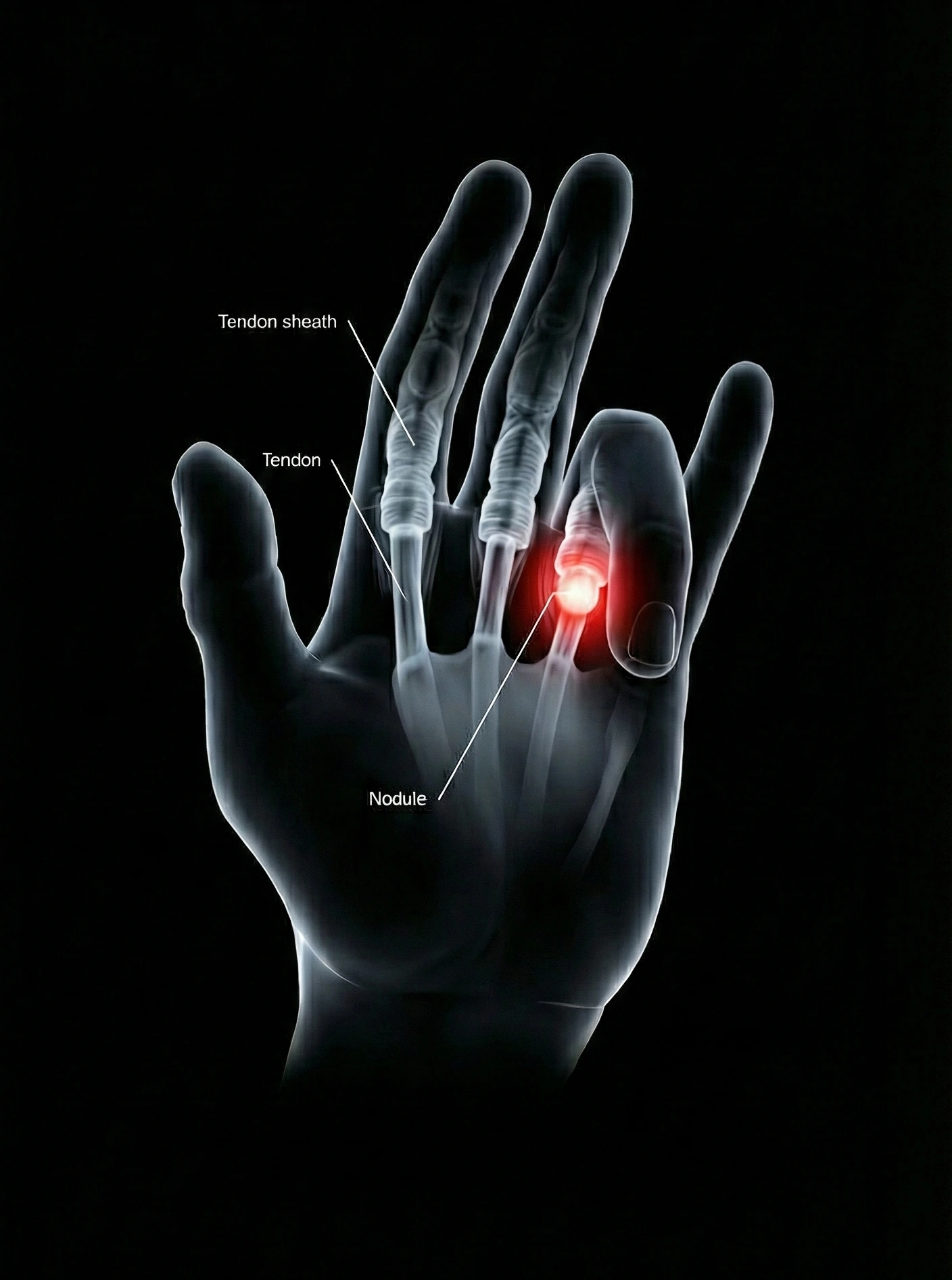
To understand how this surgery helps, it is best to visualize the anatomy of your finger as a rope moving through a guide.
The Anatomy: The "Rope and Tunnel" Your finger contains a Flexor Tendon, which acts like a long rope connecting your muscles to your fingertips, allowing you to bend them. To keep this tendon close to the bone, it passes through a series of fibrous tunnels or rings called Pulleys. The most important one at the base of the finger is called the A1 Pulley.
Before Surgery (the Locking): The problem in a case of Trigger Finger (Stenosing Tenosynovitis), the Flexor Tendon becomes irritated and inflamed. Often, a small lump, known as a Nodule, forms on the tendon. Imagine trying to pull a knotted rope through a very tight ring. The healthy tendon should glide smoothly, but the swollen nodule gets stuck at the entrance of the A1 Pulley.
The Symptoms: This mechanical "traffic jam" causes the specific symptoms you feel - locking & clicking. When you bend your finger, the nodule forces its way through the pulley. However, when you try to straighten it, the nodule gets stuck behind the pulley, locking the finger in a bent position. When it finally pops through, it snaps straight like a trigger.
Pain: The friction and pressure create inflammation, resulting in pain at the base of the finger or in the palm.
The Surgery (Cutting the A1 Pulley): During the procedure, the surgeon makes a small incision in the palm. They locate the A1 Pulley, that tight ring of tissue, and carefully cut it open. This divides the continuous band of the pulley.
The Result (Smooth Gliding): By cutting the A1 Pulley, the constriction is instantly released. The "roof" of the tunnel opens up, creating more space. The Flexor Tendon, even with the nodule still present, can now glide back and forth freely without catching or getting stuck. Over time, the pulley heals loosely, and the inflammation in the tendon usually subsides because the constant friction is gone.
After Trigger Finger Release Surgery
Restored Mobility: The flexor tendon is no longer trapped. It can now glide freely through the sheath without catching, locking, or the painful "popping" sensation.
Mechanical Correction: With the blockage removed, friction is eliminated, allowing your finger to bend and straighten with its natural smoothness.
Instant Relief: Most patients find that the clicking and "triggering" sensations vanish the moment the procedure is complete.
Long-Term Recovery While some minor soreness or stiffness at the incision site is a normal part of the healing process, the underlying cause—the constriction—is permanently resolved. This allows inflammation to subside and full hand function to return.
Rapid Recovery
We do not use general anesthesia or heavy sedation so your recovery starts the moment you sit up.
Day 0: Surgery Day
- After Your Procedure: You are encouraged to move your fingers immediately. gently bending and straightening the treated finger is crucial to prevent stiffness and keep the tendon gliding smoothly.
- Pain Management: Local anesthetic typically lasts 4 to 6 hours. Once it wears off, most patients manage discomfort with over-the-counter anti-pain medication. Heavy narcotics are rarely needed. Keep your hand elevated as often as possible for 48 to 72 hours post-surgery to reduce swelling and throbbing.
- Function: You can use your hand for light activities immediately—eating dinner, buttoning a shirt, or scrolling on your phone. Do not lift more than 5 to 10 pounds for two weeks unless instructed otherwise by your Plastic Surgeon.
Days 1–3: The Healing Phase
- The Bandage: You will have a soft dressing on your hand to protect the incision.
- Showering: You can shower and wash area with soap and water 24 hours after surgery. Do not soak surgical sites (no pools, hot tubs, lake water, or dish water) for 3-4 weeks.
- Driving: You can drive as soon as you are not taking prescription pain medication and feel confident in your grip strength (often within 24–48 hours).
Day 10–14: Suture Removal
- The Reveal: Stitches will dissolve, or can be removed by your local physician or nurse (depending on the type of stitches used).
- The Scar: Because a Plastic Surgeon closed your incision, it is hidden within the natural "life line" crease of your palm. Even at this early stage, it is discreet.
- Activity: You can return to typing and other clerical work as comfort allows unless your Plastic Surgeon advises you otherwise.
3 Months: The "Invisible" Result
- Activity: Gym workouts, and heavier lifting is generally okay at this stage of recovery unless advised otherwise.
- Scar Maturity: At this point, the incision line typically fades to a thin, pale line.
- Full Strength: Grip strength typically returns to normal (or better, now that the pain is gone).
- Smooth Movement: For most patients, the locking, catching, and clicking are completely resolved, allowing for full range of motion without pain.
Canada’s Leader in Hand Surgery
Dr. Avi Islur is not just a Board Certified Plastic Surgeon; he is a highly sought-after specialist in Hand and Peripheral Nerve Surgery. With a combined experience of thousands of successful releases, Dr. Avi Islur focuses on restoring function and quality of life for patients across Canada.
Restore Your Hand Function Today
Don't wait in pain. Bypass the public waitlists, regain your grip, and get back to the life you love.
Board Certifed Plastic Surgeon
Your relief is our reputation. Entrust your recovery to Award-Winning, Board Certified Plastic Surgeon Dr. Avi Islur. Renowned for delivering safe, life-changing surgical results, Dr. Islur's ultimate goal is the same as yours: to safely restore smooth, effortless movement to your hands, so you can get back to doing what you love.
Your Transformation Begins Here
Your surgical outcome deserves our undivided attention. To ensure the meticulous care your journey requires, we recommend securing your consultation and procedure dates well in advance. Connect with our Patient Care Coordinators at (204) 885-1419 for personalized assistance.